my life in the sunshine season 1 episode 1
Down Here, We Worship Secrets
Mar 01, 2026
It’s time to feed these cats.
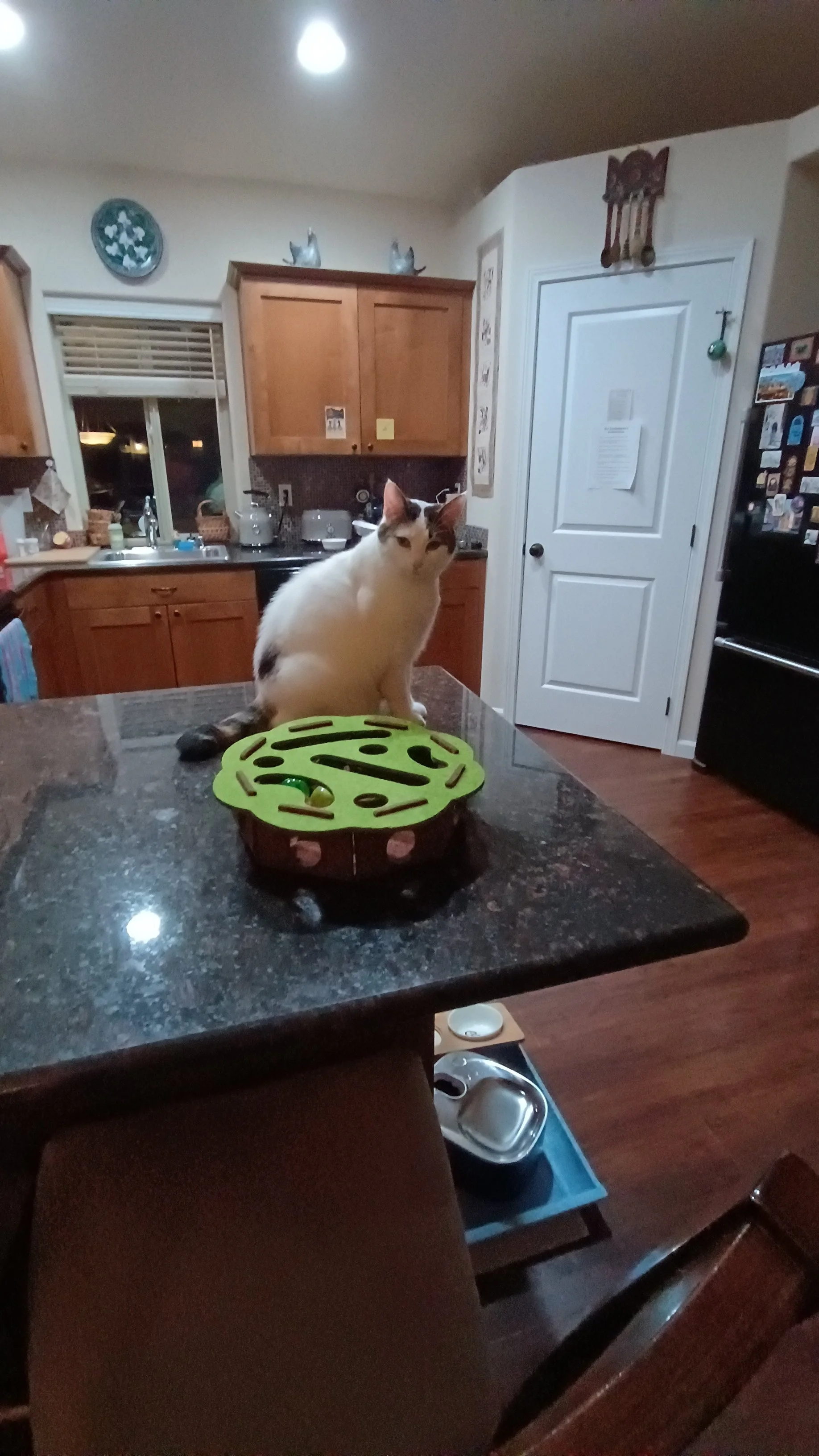
Another rainy morning in Sequim, WA. The air is light and fresh and I can smell the water from the Peninsula from here. The homeowner, Judith, is in Mexico while I care for her two uniquely qualified-in-companionship cats. Snickers is on a special diet blend because she steals Clawdia’s food. Clawdia handles this betrayal with the resigned dignity of someone who has seen too much.
This place is gorgeous. Serene. Judith decorated it in Aztec and ancient Mexican motifs. Color and texture everywhere, a whole personality pressed into every corner. I stood in the middle of it and did what I always do. I framed it. Decided where the light was best. Filed it away. I feel like a guest inside her most honest self.
I should really put on some clothes.
Judith warned me that floor-to-ceiling windows in the living room means the neighbors get a show if I’m not careful. I put on underwear. Not a bra. I don’t really need a bra — when I wear one it’s only to keep my nipples from pressing through my shirt. When the weather is warm I move around in a bikini. Today is not warm. Today is grey and damp and smells like pine and rain.
I start making tea.
Cherry.
I stopped. Turned around slowly. That smell. Cherry tobacco — warm, sweet and smoky, curling in from somewhere I couldn’t see. My mouth lifted before my brain could ask why. My eyes closed on their own.
I walked to the front door and opened it.
No one there. Just the wet sidewalk and the grey Sequim morning. But the smell hung in the air so vividly I almost reached for it.
Bobby.
Bobby Pittfield. My daddy’s friend. Big man. Always brought me candy. Always smelled of cherry tobacco from his pipe. I’d climb up on him like a tree and he’d laugh from somewhere deep in his stomach.
Bobby has been long gone for decades.
I stood in the doorway a moment longer than necessary. Then I went back inside.
And just like that — I was back in Louisiana.
One of Judith’s many Mexican decor pieces
It was 54 degrees and partly cloudy in Lafayette, Louisiana January 1974.
I was born 6 pounds and 7 ounces at Charity Hospital to a short, dark-skinned girl from Donaldsonville and a tall, slim, recently-discharged-from-Vietnam man from Morgan City. I was the first in my name from the house of Carbins. Some of my kin let the N end things — Carbin. My daddy chose to add the S.
They called me Starlet.
For the first five years of my life, it was just me and whatever version of my parents was available that day. My little brother came eventually. Louis Jr. They said he was jaundiced. He didn’t come home right away.
I didn’t want him home at all.
What did we need him for?
Lil Louis was a quiet baby. Still. He had a sweet, troubled little face and he didn’t like noise, so naturally I made as much of it as possible. I had a whole life before he arrived. My daddy’s music, his friends coming over late, card games and dancing, the green table covered in grass that his friends would stop by to touch, roll things in, and then leave. I used to sit on the floor near that table and watch them. The way the light moved through the window and caught the smoke, the hands, the laughing faces. I didn't know the word composition yet. I just knew I couldn't stop staring.
I had toys and records and jewelry. My room was full.
My favorite record was the Cinderella soundtrack. I’d play it over and over until I had every word memorized, humming it when I was supposed to be quiet — bibbidi, something-something, boo — spinning in circles in the kitchen while my mother’s face did that thing it did.
“Girl. I said be quiet.”
“But daddy lets me—”
“Your daddy aint here right now, is he.”
It wasn’t a question.
When Daddy was home, everything felt different. Loud and alive and full of possibility. When baby Louis cried too much and my mother’s face went tight, Daddy would pull her into the kitchen. I’d hear raised voices, then a different kind of sound — something crashing, something muffled. Then quiet.
Daddy would come out first. Straighten his collar.
“Baby, you can do whatever you want. You want to come take a ride with me?”
“Yes!”
“Go get your baby doll.”
I’d run upstairs and pack my favorite things while my mother stood in the kitchen doorway holding her face. Sometimes there was blood. I noticed. I filed it somewhere I didn’t have words for yet.
“Mama, what happened to your face?”
“She’s ok baby,” Daddy would say. “Your mama’s clumsy. Go get in the car.”
“Ok daddy.”
I loved leaving with my daddy. I always came back with new clothes, new toys, and money.
We didn’t always stay in Louisiana. Sometimes we drove all day and all night, stopping at hotels where I could order anything I wanted off the menu. I especially loved pickled pigs feet and BBQ chicken. Daddy had friends everywhere in other cities, other states, other lives I only saw the edges of.
“Where are we going this time, daddy?”
“We’re going to see Foxy Brown, baby. You’re gonna love California.”
I believed everything he said.
We lived in the projects. That’s important to understand. Our house wasn’t really a house. It was a unit in a development where everyone’s business was everyone’s business. Where walls were thin and windows faced other windows and the distance between one family’s secrets and another’s was about eight feet of concrete.
My mother had a friend we called Aunt Terry. She had five kids. There were her three sons, and two daughters. Her youngest daughter, Easton, was my age.
Easton told me I was black.
“You’re black and I’m bright.”
“You’re black too.”
“Yeah but you’re black dark. I’m light bright.”
I didn’t have a response for that. I stored it in the same place as my mother’s face.
I wouldn’t let Easton play with my toys. I wouldn’t let any of them touch my things. I’d learned that from the white family my mother cleaned for. They were two kids who kept their toys in rooms I wasn’t allowed in. I implemented the policy immediately.
“No. That’s my toy.”
“Don’t be selfish,” my mother said, reaching for the switch. “You share with your cousins.”
“But those white kids don’t have to share with me.”
She beat me for being sassy. I never understood the logic. If the toy belongs to me, don’t I have the same right they do? I asked her that out loud once.
She beat me again for that too.
1979.
I was five years old.
Aunt Terry’s older sons were named Don and Guzz. There was a third brother, Cooper. Everyone called him Cookie.
What they did to me started the first time my mother took me to their house and left me there. It continued for six years.
Don would hold my face and give instructions like they were reasonable things to say to a child. Guzz would follow his lead. I learned quickly what they wanted. I learned which thing hurt more and which one I could survive easier — that a mouth was easier than the other places, that going still was better than fighting, that making a small sound sometimes made it stop sooner than making no sound at all.
Cookie was less rough than his brothers, which is a sentence I can write now without flinching only because I’ve had years to understand that less rough is not the same as gentle and neither one is the same as right.
Their older sister, Rochelle, would peek into the room sometimes. She’d laugh, close the door, then walk back down the hall.
I filed the information away the same place I’d filed everything else — the crashing sounds in the kitchen, my mother’s bloody face, Easton’s light bright speech. There was a room inside me filling up with things that didn’t have names yet.
They told me to keep it a secret.
So I did.
And the thing about secrets, growing up down here, is that keeping them was never really a choice — it was just the weather. Everyone was keeping something. The neighbors. The church mothers. Aunt Terry with her hot corn bread and her Sunday smile. My mother, standing at the sink.
Down here, we worship secrets.
By the time I was eleven the whole neighborhood had its rituals. A roundtable of kids who had learned from adults that bodies were communal property, that age was a suggestion, that what happened in back rooms didn’t leave back rooms. We all participated. We all kept quiet. We all went home and ate dinner and got bathed and were told to say our prayers.
I said mine.
Please God. Let daddy take me on a ride.
The day everything changed, we left in a taxi.
My mother moved fast and quiet, like someone had told her she had one hour and no second chances. Baby Louis was wrapped in a blue blanket with the letter L stitched on the front. I stood in the doorway of my room looking at my toys along with all my records, dolls and jewelry. I understood somehow that we were not coming back for them.
“Mama. Why are we leaving?”
She didn’t answer.
“Mama. Where is daddy?”
“Get in the taxi cab, Starlet.”
The driver loaded two bags into the trunk. My mother held baby Louis against her chest and stared straight ahead. I climbed in and pressed my face against the window and watched our building get small.
I didn’t cry. I was too angry to cry.
She was taking us away from our stuff. Away from our home. Away from our daddy.
Away from Don and Guzz and Cookie, but I didn’t understand that yet. That part of the math wouldn’t make sense to me for a long time.
I just knew I was being taken somewhere I didn’t choose, by a woman who never hugged me. We were leaving everything I had behind in a room in the projects-Brownell Homes- St Mary Parish Louisiana.
She called me Starlet like it was an accusation.
Daddy called me Starlet like I was something rare.
And now daddy was gone and we were in a taxi and Brownell Homes was behind us.
I pressed my forehead to the cold glass and watched our building get small. I held the image until it was gone, the way I would later learn to hold a frame before pressing the shutter. Some part of me already knew: if you don’t capture it, it disappears.
Remember this, I told myself. Remember exactly how this feels.
Next episode: The new house. The new rules. The things that followed us in the suitcase we didn’t pack.